
You are standing in your bedroom the night before a week-long trip, a small suitcase open on the bed, and a pile of clothes beside it that looks far too big for the bag. You have done this before: you sit on the lid, force the zip shut, and spend the first day of your holiday ironing creased shirts. There is a calmer way to do it. Packing a carry-on for a week is not about squeezing harder. It is about choosing fewer, better pieces and giving each one a fixed place in the bag.
This guide shows you how to pack a carry-on for a week-long trip, from the capsule wardrobe to the liquids bag, so you arrive with everything you need and nothing you have to drag around.
Start With the Rule That Makes It Possible
One bag for seven days works only if you accept one rule before you open the wardrobe: every item must earn its place twice. A shirt earns its place if it goes with at least two bottoms and suits at least two occasions, such as a daytime walk and an evening meal. A pair of shoes earns its place if you will wear it on at least three days. If an item works for only one outfit, leave it at home.
Before you pack, check two practical things: your airline’s published carry-on size and weight limits, which vary between airlines, and the day-by-day weather for your destination. Packing for the forecast you actually have, rather than the trip you imagine, is what stops the bag from filling up with just-in-case items.
Build a 7-Day Capsule, Not Seven Outfits
Think in a small colour family, not in outfits. Choose two neutral base colours, such as navy and grey, plus one accent colour. When everything sits in the same family, a top planned for Tuesday also works on Friday.
A workable capsule for a week looks like this: four or five tops, two bottoms, one dress or one smart shirt if your plans need it, one light layer, and one outer layer suited to the forecast. Add sleepwear, underwear for seven days, and one set of workout or swim clothes only if you genuinely plan to use them. Most travellers over-pack in exactly two places: extra tops and extra shoes. Fix those two, and the bag usually closes easily.
Fabric matters more than quantity. Choose clothes that resist creasing, dry quickly, and layer well. A top you can wear twice is worth more in a carry-on than three delicate tops that need ironing after one wear.
A Simple 7-Day Packing List
| Category | What to pack |
|---|---|
| Tops | 4–5 tops in your capsule colours, including one smarter option |
| Bottoms | 2 bottoms, such as one pair of trousers and one pair of jeans or a skirt |
| Layers | 1 light layer and 1 weather-appropriate outer layer |
| Underwear and sleepwear | 7 sets of underwear, 7 pairs of socks, 1 sleep set |
| Shoes | 1 pair worn for travel, 1 extra pair packed flat |
| Toiletries | Travel-size essentials in one clear liquids bag |
| Essentials | Passport or ID, phone, charger, medication, a pen |
Wear your heaviest items on the plane: the bulky shoes, the coat, and the heaviest layer. This one habit frees more space than any packing gadget. Keep the items you will need during the flight — headphones, a book, snacks, and medication — in your personal item, not buried at the bottom of the suitcase.
Roll, Fold, or Use Packing Cubes?
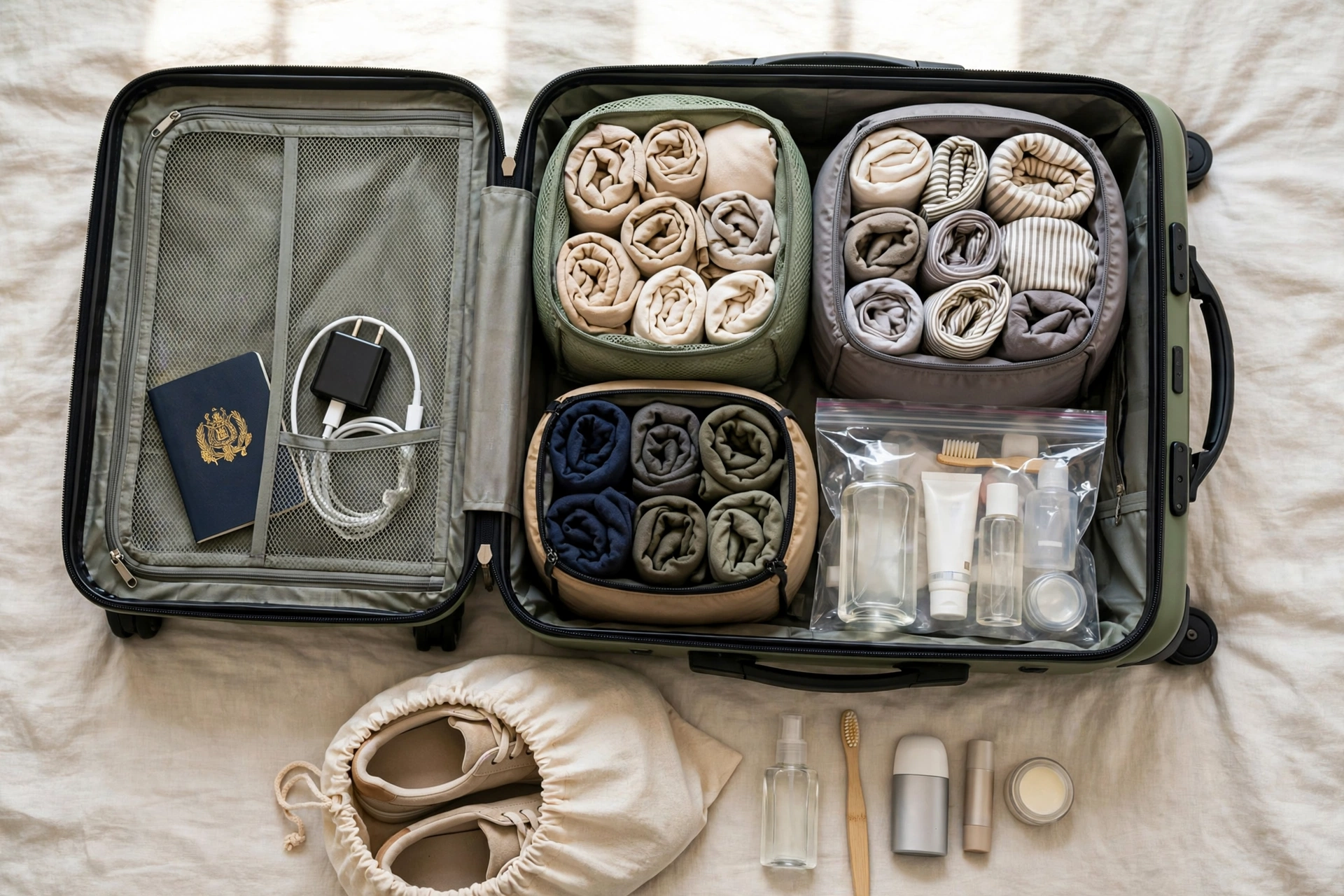
All three methods work. Rolling soft items such as T-shirts saves space and reduces creases; folding works better for structured shirts and trousers. Packing cubes do not create space by themselves, but they keep categories separate, so you can lift out the tops cube without disturbing everything else.
A practical combination is to roll casual clothes into one or two cubes, fold smarter clothes flat on top, and keep small items in a third cube. Fill gaps with socks, belts, and chargers in small pouches: a full, flat bag travels better than a half-empty one, because loose items shift and crease in transit.
Liquids, Toiletries, and the Clear Bag
For flights, most airlines and airports follow a familiar liquids rule: each container must be small, typically 100 millilitres or less, and all containers must fit in one small transparent, resealable bag. Rules and enforcement can differ by airport, so check your departure airport’s guidance before you travel rather than assuming the bag you used last time will pass this time. Decant shampoo, moisturiser, and other liquids into travel-size bottles, and leave full-size bottles at home.
Keep the liquids bag at the top of your suitcase or in an outer pocket so you can take it out quickly at security. Travel-size versions save weight and space, and choosing travel-size oral care products for your journey is one easy way to keep your wash bag compact. If you take medication, carry it in your personal item, and check your destination’s rules for any medicine that needs documentation.
Shoes, Tech, and the Personal Item
Shoes take up the most space for the least use, so limit yourself to two pairs in total, including the pair you wear. Choose one comfortable walking pair and one pair that can handle an evening out. Stuff socks or small items inside packed shoes to use the hollow space, and place shoes in a dust bag or a plastic bag so they do not mark your clothes.
For tech, pack only what you will use every day: phone, charger, and one cable if possible. A small power bank is worth its weight on long travel days. Your personal item — a backpack or tote that fits under the seat — should hold valuables, documents, medication, and anything you cannot afford to lose if your suitcase is delayed. Never pack passports, wallets, or essential medication in a bag you hand over at the gate.
Pack in This Order
- Lay out the full capsule on the bed and remove anything that matches only one outfit.
- Place shoes at the bottom of the suitcase, in bags, with small items stuffed inside them.
- Add rolled casual clothes in packing cubes, then folded smarter clothes on top.
- Put toiletries and the liquids bag in an outer pocket or on top for easy access at security.
- Place your outer layer on top, so it is easy to grab when you land.
- Close the bag, weigh it if your airline has a weight limit, and remove one item before you leave — almost every traveller can find one.
Frequently Asked Questions
Can you really pack for a week in a carry-on?
Yes, for most leisure and city trips, if you pack a capsule wardrobe rather than a separate outfit per day, wear your heaviest items, and limit yourself to two pairs of shoes. Trips that need bulky specialist gear, such as ski equipment or formal evening wear for several events, are the exception and may genuinely need a larger bag.
How many clothes do you need for seven days?
Four or five tops, two bottoms, and one or two layers will cover a week when the colours coordinate and fabrics can be reworn. Underwear and socks are the exception: pack a fresh set for each day, since those are small, light, and not worth washing on a short trip.
What should go in your personal item instead of the suitcase?
Documents, money, medication, valuables, chargers, and anything you need during the flight. If your suitcase is delayed or you are asked to gate-check it, your personal item is what keeps the first day of your trip comfortable.
Final Thoughts
Packing a carry-on for a week-long trip is a small exercise in decision-making: fewer choices, made before you leave, mean a lighter bag and a calmer arrival. Choose a capsule, pack it flat, keep liquids and valuables where you can reach them, and remove one item before you zip up. You will not miss the extra shirt. You will notice the extra space, the shorter wait at baggage reclaim, and the fact that your holiday starts the moment you land, not after you unpack.