

You step off the night bus in a city you have never seen before, your backpack heavy on your shoulders and your phone in your hand as you check the map to your hostel. Everything you need for the next few weeks — your passport, your cards, your camera — is in that bag or in your pockets. Keeping it all safe is a skill you build trip by trip, not something you leave to luck.
The good news is that most theft on the road is opportunistic, not planned. A thief takes what is easy to reach and easy to grab. So the goal here is simple: make your valuables hard to reach, hard to grab, and impossible to lose all at once.
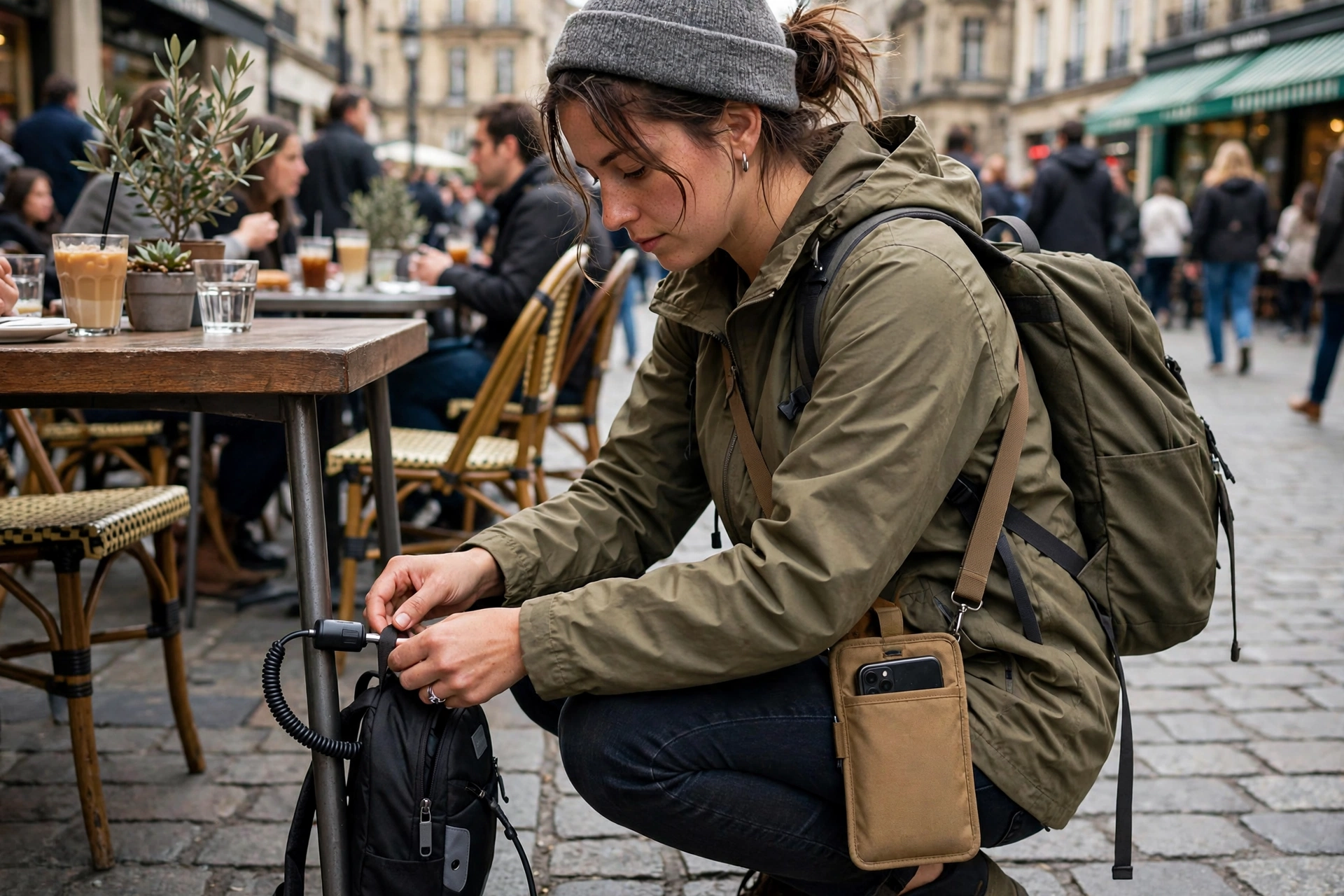
Keep Your Valuables on Your Body or in Your Sight
The single most effective rule in backpacking security is also the simplest: the things you cannot afford to lose should stay on your body or within your sight. Your passport, your main bank card, your phone, and most of your cash belong in a money belt, a hidden pouch under your clothes, or a secure inner pocket — not in an outer pocket or a bag you set down.
Keep only what you need for the day in your wallet or daypack: a small amount of cash and one card. The rest stays hidden. Even if a pickpocket gets your wallet, the loss is small and your trip continues. The same logic applies on overnight buses and trains — sleep with your valuables in a pouch against your body, not in a bag on the rack above you.
Choose the Right Bag and Lock It Properly
Your backpack is your home on the road, so choose one that helps you rather than works against you. Look for a bag with lockable zippers, a hidden pocket against your back, and a design that does not scream expensive gear. A plain, well-worn bag attracts far less attention than a brand-new one covered in patches and carabiners.
Carry a small padlock and a lightweight cable lock. The padlock secures the main compartment zippers together when your bag is in a hostel dorm or left in luggage storage. The cable lock lets you tether your bag to a bed frame, a luggage rack, or a fixed rail on a bus or train, so nobody can simply walk off with it while you sleep or step away. Packing your valuables into your carry-on rather than a checked bag matters too — if you are flying between stops, knowing how to pack a carry-on for a week-long trip keeps your essentials with you instead of in a suitcase you cannot watch.
Split Your Cash, Cards, and Documents
Never keep all of your money and documents in one place — this is the rule that saves trips. Split your cash between your money belt, your daypack, and a second hidden spot in your main bag. Carry two bank cards from different accounts if you can, and keep them apart: one on your body, one locked in your bag. If one card is lost or blocked, the other keeps you going.
Do the same with your documents. Keep your passport in your money belt, but carry a photocopy — paper or a photo on your phone — for everyday ID checks at hostels and ticket counters. Store a digital copy of your passport, travel insurance details, and emergency numbers in your email or a secure cloud folder, so you can reach them from any device if your phone disappears.
Use Hostel Lockers and Hotel Safes Wisely
Most hostels provide lockers, and most budget hotels have a safe or a locked drawer at reception. Use them — but use them properly. Bring your own padlock, because hostel lockers often come without one or with a flimsy lock. Choose a locker big enough for your valuables and test that it closes and locks before you walk away.
Hotel safes are useful for a laptop or camera, but do not treat them as perfect. Keep your passport and main cash on your body when you are out, and use the safe only for items you do not need during the day. In a shared dorm, never leave valuables charging unattended — sit with your phone, or use a short cable that keeps it in your pocket while it charges from a power bank.
Stay Alert in Crowds, Transit, and Nightlife
Most theft happens in predictable places: crowded markets, busy metro stations, festival crowds, and packed bars. In these spots, wear your daypack on your front, keep zippers facing your body, and keep a hand on your bag when you stop to look at something. Distraction is the oldest trick in the book — someone asks for directions or bumps into you while a partner reaches for your pocket. If a stranger’s behaviour feels staged, step back into a shop or a lit area and check your belongings.
At night, the same awareness applies. Do not walk alone through quiet streets with your phone in your hand and headphones in. Keep your phone in a front pocket, take well-lit main roads, and use registered transport rather than accepting a ride from someone who approaches you. Many of the tricks aimed at travellers are variations on the same theme, and learning how to avoid tourist scams in a new city will sharpen your eye for the setups that usually come just before a theft.
Protect Your Phone and Camera
Your phone is usually the most valuable thing you carry, and the one you use most in public. Set a strong screen lock, turn on your phone’s built-in tracking and remote-lock feature before you travel, and back up your photos regularly so a stolen phone does not mean lost memories. Avoid holding your phone loosely at arm’s length near roads, where snatch-and-grab theft from passing motorbikes is common. Use a wrist strap on your camera, and keep it in your bag in a crowd.
What to Do If Something Is Stolen
Even careful travellers sometimes lose something. If it happens, act quickly and calmly. First, cancel your cards through your bank’s app or helpline. Second, use your phone’s tracking feature to locate or remotely lock the device. Third, report the theft to the local police and get a written report — your travel insurance will almost certainly ask for one before paying a claim. Then contact your embassy or consulate if your passport was taken — they can issue emergency travel documents, and the copies you stored will speed that up.
Tell your hostel or hotel too — staff often know if an area has had a run of thefts. Finally, do not let one bad day end your trip. Replace what you must, lean on the backups you prepared, and keep going.
FAQs
Should I carry my passport with me every day while backpacking?
In most cases, yes — keep it in a money belt or a secure inner pocket, and carry a photocopy for routine checks. Leave the original locked up only when the locker or safe is reliable and you will not need ID that day. A few countries require you to carry your original passport at all times, so check local rules.
Is a money belt really necessary?
It is the cheapest and most effective piece of security gear a backpacker can own. It keeps your most important items invisible and out of reach. A hidden pouch or a zippered inner pocket works too — the point is that your core valuables are not in a pocket a stranger can reach.
Are hostel lockers safe enough for a laptop?
Usually yes, if you use your own sturdy padlock and the locker is solid and well fixed. In very cheap or informal hostels, carry your laptop in your daypack instead, or choose a hostel with reviews that mention secure storage.
Final Thoughts
Keeping your valuables safe while backpacking comes down to a few habits: carry the important things on your body, split what you own so one loss never ends the trip, lock your bag whenever you leave it, and stay alert where crowds gather. Together these habits remove the easy opportunities thieves rely on. Pack smart, stay aware, and spend your energy on the journey itself — that is what you came for.