

Picture this: you are at the airport, your flight boards in an hour — then you realise your daily medication is in the suitcase you have just checked in, or in an unlabelled box a border officer is now asking about. A little preparation can prevent that moment entirely. Travelling with medication safely abroad is mostly about three things: knowing the rules of the places you will enter, keeping your medicine identifiable and within reach, and having a backup plan if something goes wrong.
This guide follows the order you will need it, from the appointment before departure to what to do if medicine is lost. It is general travel information only, not medical or legal advice for your prescription — for that, talk to your own doctor or pharmacist before you travel.
Start With Your Doctor and Pharmacist Before You Leave
Book a short conversation with your prescriber well before departure, not the night before your flight. Take a complete list of everything you use regularly, including over-the-counter products and supplements, because a product sold freely at home may be treated differently abroad.
Ask specifically about:
- Whether dose timing must change across time zones, and what to do if you miss a dose.
- Whether your medicine needs refrigeration or protection from heat during a long journey.
- Whether you need a doctor’s letter, especially for controlled medicines or injectables such as insulin.
- Whether you can get an early refill to carry enough for the trip plus a few extra days.
- The generic name of each medicine, since brand names often differ by country.
Your pharmacist can also confirm storage instructions and warn you when a smaller travel container is a poor idea — for example, when the original pharmacy label is the proof you will need at a border.
Check the Rules for Every Country on Your Route
A prescription from home does not automatically make a medicine legal somewhere else. Each country sets its own laws on which medicines may enter, in what quantity, and with what paperwork. A routine medicine at home may be controlled or prohibited at your destination, and getting this wrong can range from confiscation to refusal of entry.
Check the destination country’s embassy or consulate guidance, and do the same for any layover or transit country, since you may pass through its customs controls too. The U.S. Centers for Disease Control and Prevention (CDC) advises travellers to check with the destination’s embassy, noting that many countries allow a limited supply of certain medicines — often around 30 days — but may also require a prescription or medical certificate. Rules vary by medicine and destination, so treat any general figure as a starting point, not a guarantee. Read the CDC’s guidance on travelling abroad with medicine, then check the specific rules for your own trip.
If a medicine you depend on is not allowed at your destination, do not simply leave it behind. Ask your prescriber about lawful alternatives and for a letter describing your condition and treatment plan. If a permit or advance approval is required, apply in good time — these processes are rarely instant.
Pack Medication So It Stays With You and Identifiable
The most important packing rule is simple: keep medicine you depend on in the bag you carry with you, never only in checked luggage. Checked bags can be delayed or lost, and a day or two’s delay is a minor inconvenience for clothes but a real problem for daily medication.
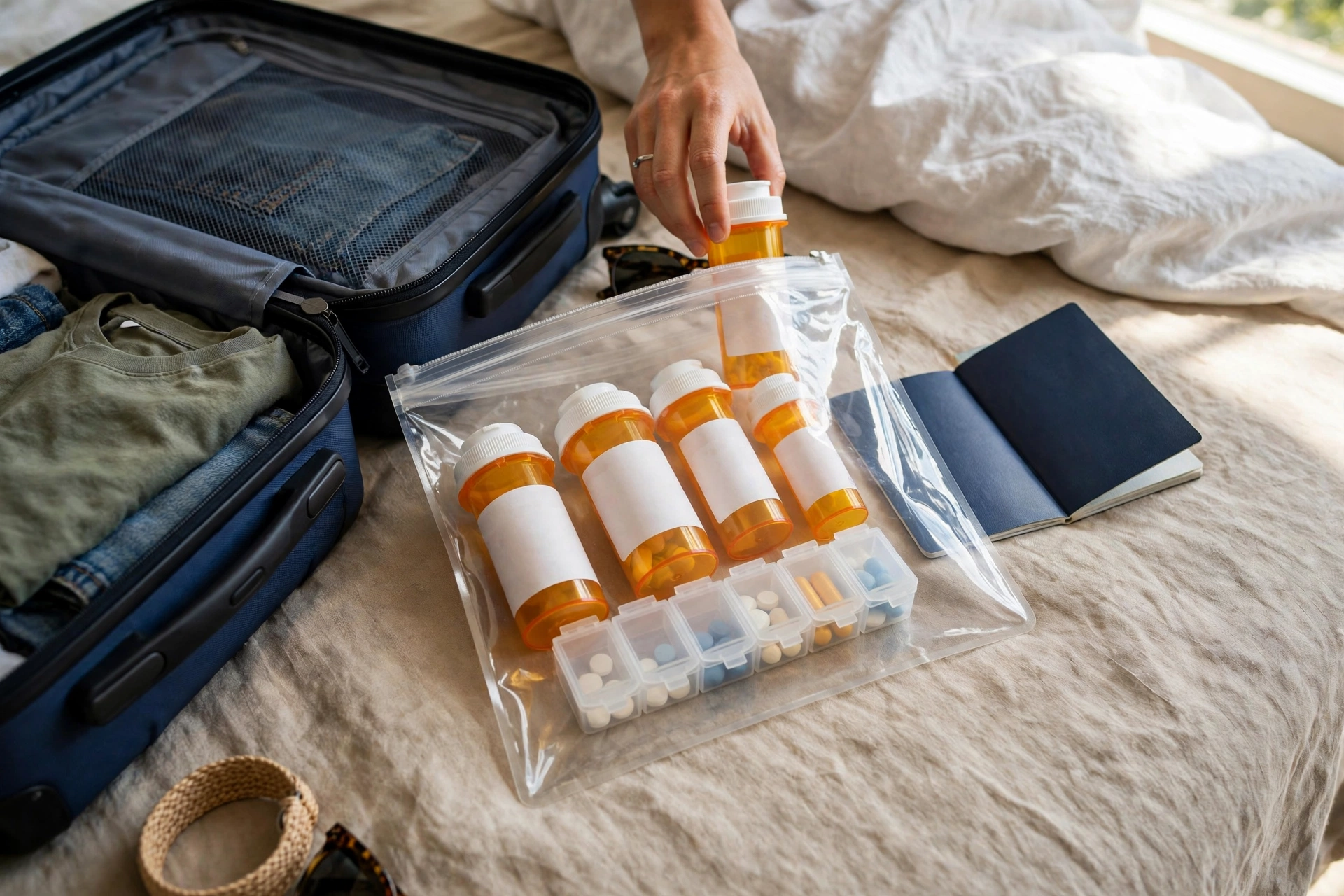
Keep prescription medicine in its original, pharmacy-labelled container for international travel. The label shows your name, the medicine’s generic and brand names, and the exact dosage — exactly what a border officer or a pharmacist abroad needs to identify it. A weekly pill organiser is convenient once you have arrived, but an unlabelled organiser alone can be hard to identify at a border, so do not discard the original packaging to save space. For help organising the rest of your bag, see this guide on how to pack a carry-on for a week-long trip, and keep your medication pouch where you can reach it most easily.
Carry copies of all your prescriptions, including the generic names, and leave another copy at home with a trusted friend or relative. Pack enough for the entire trip plus extra for delays, and keep your daily dose accessible during the flight rather than buried at the bottom of your bag.
Manage Doses Across Time Zones
Time-zone changes are where travellers most often make mistakes, usually by switching straight to the local clock. For many medicines, what matters is the time since your last dose, not the hotel clock. Before you travel, ask your prescriber how to handle the shift for your medicines, especially if you take doses several times a day or timing matters.
Once you have a plan, make it easy to follow: set phone alarms for dose times, and note when you last took each medicine while adjusting. If unsure whether you already took a dose after a broken night’s sleep, do not guess and double up — follow your prescriber’s missed-dose advice, or seek local medical advice.
Store Medication Properly on the Move
Heat, humidity and freezing temperatures can reduce how well some medicines work, so storage deserves the same attention as packing. Read the label’s storage instructions, and ask your pharmacist if anything about your journey — a long bus ride in hot weather, a hotel room without reliable refrigeration — could be a problem.
For medicine that needs to stay cool, use an insulated pouch and plan where it will go on arrival. Otherwise, keep medicine in your room, not in a parked car or a bag in direct sun. If a medicine looks or smells different after extreme heat or cold, ask a pharmacist rather than assuming it is fine.
If Medication Is Lost, Delayed or Confiscated
Even careful travellers lose bags. If your medicine goes missing, act quickly but calmly: contact your airline or hotel about delayed luggage, and use your prescription copies and doctor’s letter to explain exactly what you need to a local pharmacy or clinic. A pharmacist abroad may recognise the generic name even when the brand name is unfamiliar.
Do not borrow someone else’s prescription medicine, and do not buy from unlabelled sellers — counterfeit medicines are a real problem in some countries, so use a licensed pharmacy and check packaging carefully. If you cannot replace a medicine locally, contact your travel insurer and prescriber, and seek care promptly if missing doses could put your health at risk.
FAQ: Travelling With Medication Abroad
Can I use a pill organiser instead of the original bottles?
For day-to-day use after arrival, an organiser can be helpful. For border crossings, original labelled containers are safer, because they identify the medicine and the person it was prescribed to. Many travellers do both: original containers for the journey, and an organiser filled from them once they have arrived.
Do I need a doctor’s letter for every medicine?
Not necessarily for every routine prescription, but a letter is strongly advisable for controlled medicines, injectables and anything needing needles or special equipment. When in doubt, carry one — a short letter on clinic letterhead listing your condition, medicines, dosages and generic names can save a long conversation at a border.
Can I just buy the same medicine when I arrive?
Sometimes, but do not count on it. The same medicine may be sold under a different brand name, in a different strength, or only with a local prescription — or not be available at all. Bring enough from home, and treat any local purchase as a backup, not the plan.
What about liquid medication on flights?
Medically necessary liquids are generally treated differently from ordinary liquids at security, but the process varies by airport and airline. Declare liquid medication at security, keep it accessible, and check your airline’s guidance before you fly.
Final Thoughts
Travelling with medication safely abroad comes down to preparation done once, before departure: a conversation with your prescriber, a check of each country’s rules, medicine in labelled containers in your carry-on, and prescription copies within reach. Do that, and medication becomes one less thing to worry about. If your situation is unusual — a controlled medicine, a refrigerated injectable — get specific advice before you leave rather than relying on general guidance alone.